
Relationship Calculator: a Bond Score Game for Any Two People
Partner, parent, friend, colleague or rival: a score for fun, ideas to reach out and games for two, in your browser
Guide reviewed 12 November 2026 by Milan Salvi. How we write and correct guides.
Open Relationship Calculator →Step-by-step help guide and questions and answers for this tool.
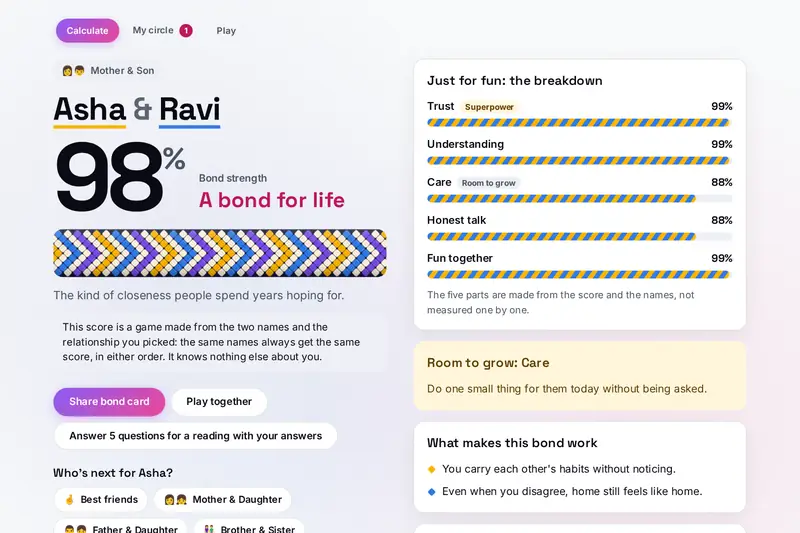
Table of Contents
Overview
Name games are usually about couples. This one works for any two people in your life: your mother, your brother, a grandparent, an in-law, your best friend, a colleague, a mentor, a rival, an ex, even your dog. Type two names, choose how they are connected from over 70 relationships, and get a bond score with a short reading, five parts with one marked as room to grow, a small idea to try and a message you could send today.
The score is a game, and the page says so under every result: it comes from the two names and the relationship you pick. Five optional questions, written for each kind of bond, let your own answers set a little over half of it. Every bond you calculate goes to My circle, which suggests one small step a day, and two games for two, who is more likely and talk cards, give you something to do together.
All of it runs in your browser: the names, answers and bonds stay on your device, and the picture card is drawn there too.
Key Features
Any Two People
Over 70 relationships in seven groups, from love and family to work, rivals, exes and pets, or name your own.
Same Names, Same Score
Either order, any capitals and accents typed two ways all give the same result, so nobody can press again.
A Reading with Ideas
Five parts for that kind of bond, room to grow, a small thing to try and a message to copy.
Five Questions
Written for couples, family, friends, work, rivals, exes and crushes; your answers set 55 percent of the score.
A Woven Band
A pattern of coloured threads made from the two names, weaving as you type and shown with every result.
A Bond Card
A picture with both names, the score and the band, to save or send from your phone.
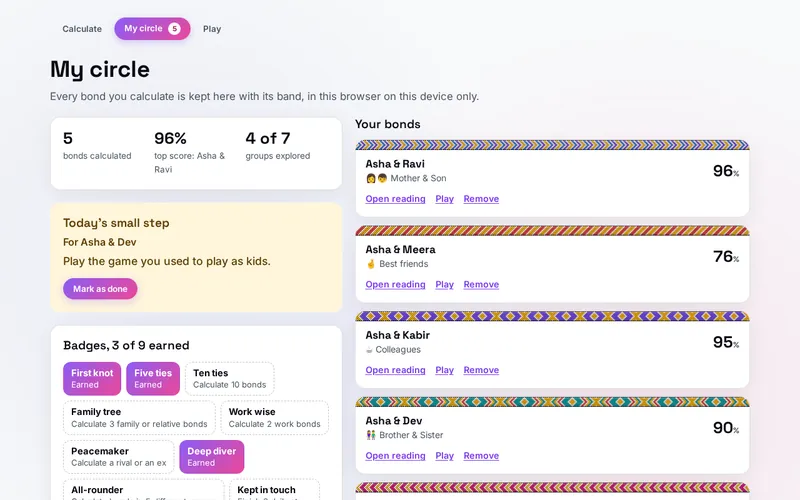
My Circle
Every bond in one place, a small step for each day and nine badges to earn.
Games for Two
Who is more likely and talk cards in decks for couples, family, friends and work.
How to Use
- Type two names - Yours and theirs, up to 24 characters each. A band starts weaving as you type.
- Choose the relationship - Pick from the groups or search with everyday words such as mom, bestie or boss; Something else lets you name your own.
- Calculate the bond - See the score with its heading and line, the breakdown, a small idea to try and a message to send.
- Answer five questions - For a reading that uses your answers, made for that kind of bond.
- Share a bond card - Save the picture or send it from your phone.
- Keep your circle and play - Find every bond in My circle with a step for today, and play who is more likely or talk cards together.
How the Tool Works It Out
- The quick score - Both names are written in small letters, with spaces, punctuation and invisible characters left out and accents written one way, and put in alphabetical order, then joined with the relationship. A fixed formula mixes that into a starting number for a seeded number generator, which gives the score: 62 to 99 for most relationships, a peace score from 52 to 98 for exes and a rivalry heat from 38 to 99 for rivals. Nothing about the people goes into it.
- The five questions - Each answer counts 3, 2, 1 or 0. Together they make a share from 0 to 1 that sets 55 percent of the score, on a range from 55 to 100 (30 to 100 for a rivalry); the name game sets the other 45 percent.
- The reading - The next numbers from the same generator spread the five parts around the score, mark the strongest and weakest, pick two lines about what often makes such a bond work and choose the first idea and message. The heading follows the score in four levels.
- The band - Each name gets one of eight thread colours; together the names pick a third colour, the stripe widths and one of five weaves. The same names always weave the same band, whatever the relationship.
- Checked before publishing - We compared the tool with references made separately: 357,276 cases in 14 groups: the reading for about 24,000 random bonds and for every relationship with all 1,024 ways of answering the five questions, names in Latin letters with and without accents, Cyrillic, Greek, Devanagari, Arabic, Chinese, Japanese and Korean letters and emoji (the same score in either order, in any capitals, with accents typed two ways and with invisible characters), names with nothing visible in them, the thread colours and the contrast of the text on them, the woven band in both themes, finding a relationship by every word and group, saved data made to break the tool, runs of hundreds of bonds and steps with the badges and limits, today's step in four time zones, the next suggestions, the wording, names cut without splitting a character, and the spread of 90,000 quick scores against the formula's own odds. For names without accents or vowel signs, every score and part is the original version's. The original counted some different names as the same (it dropped vowel signs, so two different Hindi names could replace each other in My circle), took names made only of invisible characters, used saved data without checking it, stopped when a saved relationship had an unexpected name, counted an ex's peace score as the top bond and had two thread colours with text below the contrast level; that is fixed.
A Score for Fun, a Step for Real
The score is there to make you smile and to give you a reason to think of someone. If a number feels too low, remember where it comes from: change a nickname or the relationship and it changes, and it cannot know anything about the two of you. Even the reading with your five answers is a game that reflects your own view a little, not a test of anyone.
The useful part is what comes after the number: a small thing to try, a message you could send today, and one step a day from My circle, such as calling a parent for no reason, asking a colleague about their week or sending a friend a voice note. For rivals the ideas are about cooling things down, and for an ex about moving on. When someone has hurt you, the page says it plainly: skip the hello, you owe them nothing, and keeping your distance is fine.
The Love Calculator is the site's other name game. It is made for couples only, with a twelve-statement relationship check-in, cards for couples and a count of your days together. The Relationship Calculator is for any two people, with five questions made for each kind of bond, a woven band and a picture card, a circle that keeps every bond with a small step for each day, and cards for family, friends and work. Both say plainly that their name scores are a game.
Frequently Asked Questions
The questions people ask most are answered on the tool page, just below the tool. The full list of 30 questions, from how the score is made to the five questions, the band, My circle, the games and your privacy, is on the Relationship Calculator FAQ page, and every part of the tool is explained step by step in the help guide.
Privacy & Security
This tool has no upload step, no account and no server-side storage. The names you type, your answers, your bonds, the steps you mark done and your badges are kept only in this browser on this device, and one button in My circle clears them. The bond card is drawn on your device.
The tool asks no outside service for anything. Like every page on ZeroDataUpload, the tool page shows ads through Google AdSense and counts visits with Google Analytics; the Privacy Policy explains both.
Ready to calculate a bond? It's free, private, and runs entirely in your browser.
Open Relationship Calculator →Related

Last Updated: November 3, 2026