
Love Calculator: a Name Game for Two, with a Couple Check-in
Watch a heart fill from two names, just for fun, then talk about what really matters, in your browser
Guide reviewed 12 November 2026 by Milan Salvi. How we write and correct guides.
Open Love Calculator →Step-by-step help guide and questions and answers for this tool.
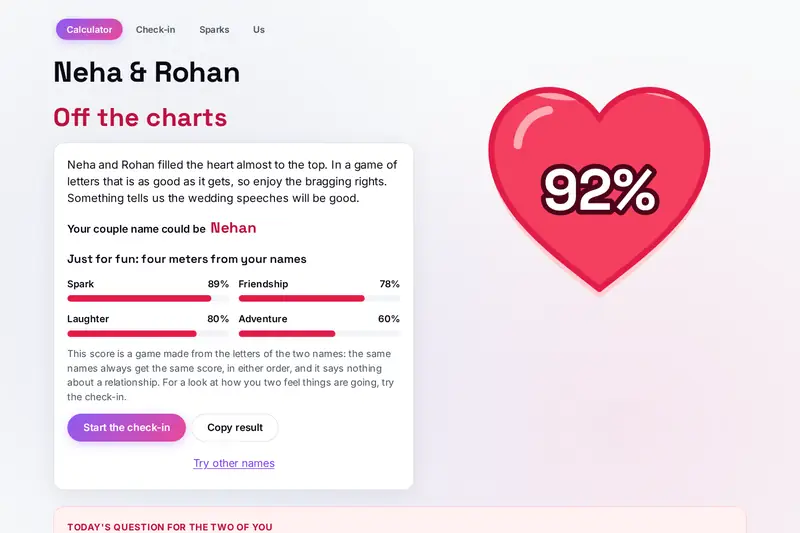
Table of Contents
Overview
Love calculators are an old party game: type two names, get a percentage, laugh about it together. This one keeps the fun of the game and is honest about it. The heart fills from the letters of the two names, the same two names always get the same score, and the page says plainly, under every result, that the score says nothing about a relationship.
Next to the game sit the parts that can actually help two people: a check-in of twelve everyday statements about talking, trust, affection, time together, teamwork and fun, answered alone or taking turns on one device; cards with questions to ask each other, date ideas and small gestures; a who is more likely game; and a count of your days together with the next anniversary.
All of it runs in your browser: the names, answers and dates stay on your device.
Key Features
A Heart That Fills
Type two names and watch the heart fill to a score from 58 to 100, with a short reading for fun.
Same Names, Same Score
No chance involved: either order, any capitals and accents typed two ways all give the same result.
A Couple Name
The first half of one name joined to the second half of the other, as in Rahul and Priya making Rahriya.
Relationship Check-in
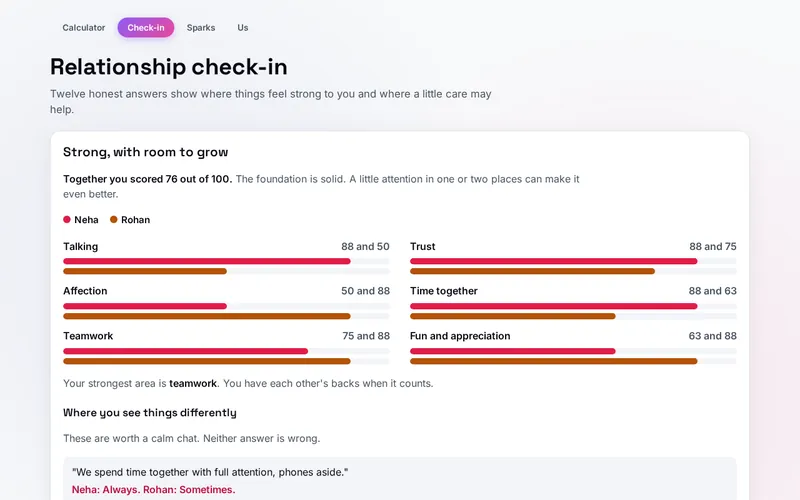
Twelve statements in six parts, scored from your own answers, with ideas for the parts that scored lower.
Answer Together
Take turns on one device, then see both scores side by side and where your answers differ.
Sparks
30 questions, 24 date ideas and 24 small gestures, with a pick for today, and cards you can save.
Who Is More Likely
A ten-round game for two: decide together who is more likely to fall asleep during a film.
Days Together
The days since you got together, the next anniversary and the next round hundred and thousand days.
How to Use
- Type two names - Your name and your partner's, and choose Dating, Engaged, Married or It's a crush.
- Calculate - The heart fills to the score, with a heading, a short reading, a couple name and four fun meters. Copy the result to send it.
- Take the check-in - Answer twelve statements from Never to Always, alone or taking turns on one device.
- Read the result - A score for each of six parts, your strongest part, and simple ideas for the parts that scored lower.
- Pick a spark - A question to ask, a date to plan or a small gesture for today; save the ones you like.
- Count your days - On the Us tab, pick the day you got together to see the days since then and what is coming up.
How the Tool Works It Out
- The name score - Both names are written in small letters, with extra spaces and invisible characters left out and accents written one way, and put in alphabetical order. A fixed formula mixes their letters into one large number, and the score is 58 plus that number's remainder after dividing by 43: always from 58 to 100. About one pair of names in 43 gets 100; the same name typed twice fills the heart too, with a note that self-love comes first. Nothing about the people goes into it.
- The reading and the meters - The heading follows the score (from A spark worth feeding to A perfect hundred), and the reading and the four meters are picked from the names with the same formula, so they too stay the same for the same names. The line for dating, engaged, married or a crush changes only the last sentence.
- The check-in - Each answer counts 0, 25, 50, 75 or 100. A part's score is the average of its two statements and the overall score the average of the six parts; answered together, both people's scores are shown and averaged. Statements answered two steps or more apart are listed to talk about.
- Days together - Days are counted on the calendar from the day you got together. Years, months and days are counted the way calendars do (a year from 29 February ends on 28 February), and an anniversary of 29 February falls on 28 February in other years.
- Checked before publishing - We compared the tool with references made separately: 552,059 cases in 13 groups: name scores for about 75,000 pairs of names in Latin letters with and without accents, Cyrillic, Greek, Devanagari, Arabic, Chinese, Japanese and Korean letters and emoji (the same score in either order, in any capitals, with accents typed two ways and with invisible characters, always from 58 to 100 and evenly spread), couple names, readings and meters, names with nothing visible in them, 20,050 check-ins answered alone and together, years, months and days between 256,256 pairs of dates compared with a well-known date library in four time zones, milestones and anniversaries, dates typed or stored, saved data made to break the tool, the list of recent results, texts cut without splitting a character, the wording, and the day number behind today's pick. The original version counted a name typed with an accent mark differently from the same name typed as one character, accepted names made only of invisible characters, wrote minus days between some dates (from 31 January to 1 March), counted a year from 29 February as 11 months and 30 days, read the year 0050 as 1950 and 30 February as 2 March, and used saved data without checking it; that is fixed.
A Game and a Check-in
The name score is there to make you smile, and it says so. Use it as an icebreaker, to tease a friend about a crush, or to see what couple name your names make. If a score feels too low, remember that it comes from the letters alone: changing a nickname changes it, and it cannot know anything about the two of you.
The check-in is different in kind. It does not grade anyone; it adds up your own answers to everyday statements so you can notice what is going well and choose one small thing to try. Answered together, its most useful part is often the list of statements where you see things differently. When the answers suggest a hard time, it says plainly that a couples counsellor can help, and that anyone who feels afraid or unsafe at home should talk to someone they trust or a helpline rather than rely on tips.
The site's other tools that pick something, the Decision Maker, SpinForge and Flip the Coin, choose at random between options you give them. The Love Calculator is the one made for two people: a name game, a conversation about how things are going, and ideas for time together.
Frequently Asked Questions
The questions people ask most are answered on the tool page, just below the tool. The full list of 30 questions, from how the name score is made to the check-in, sparks, days together and your privacy, is on the Love Calculator FAQ page, and every part of the tool is explained step by step in the help guide.
Privacy & Security
This tool has no upload step, no account and no server-side storage. The names you type, your check-in scores, your saved sparks and the day you got together are kept only in this browser on this device, and one button on the Us tab clears them all. The answers to the check-in are not kept at all.
The tool asks no outside service for anything. Like every page on ZeroDataUpload, the tool page shows ads through Google AdSense and counts visits with Google Analytics; the Privacy Policy explains both.
Ready to fill the heart? It's free, private, and runs entirely in your browser.
Open Love Calculator →Related

Last Updated: November 3, 2026