
Interactive Periodic Table: Every Element, Every Value Sourced
Heat the table, rewind history, chart the trends and work out chemistry with all 118 elements, in your browser
Guide reviewed 12 November 2026 by Milan Salvi. How we write and correct guides.
Open the Periodic Table →Step-by-step help guide and questions and answers for this tool.
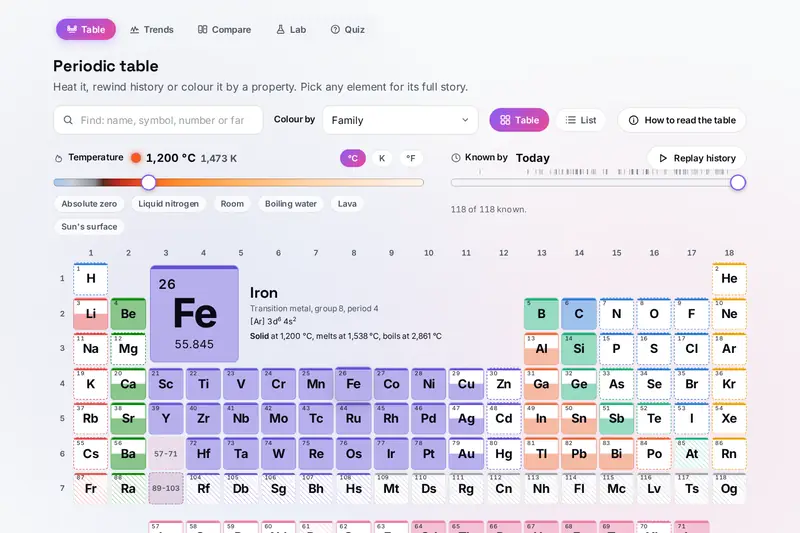
Table of Contents
Overview
A printed periodic table shows each element in a box. This one lets you do things with it: drag a temperature slider and watch the elements melt and boil, move a year slider and watch them appear in the order they were discovered, colour the table by any property to see the patterns that give the table its name, and open any element for its full story.
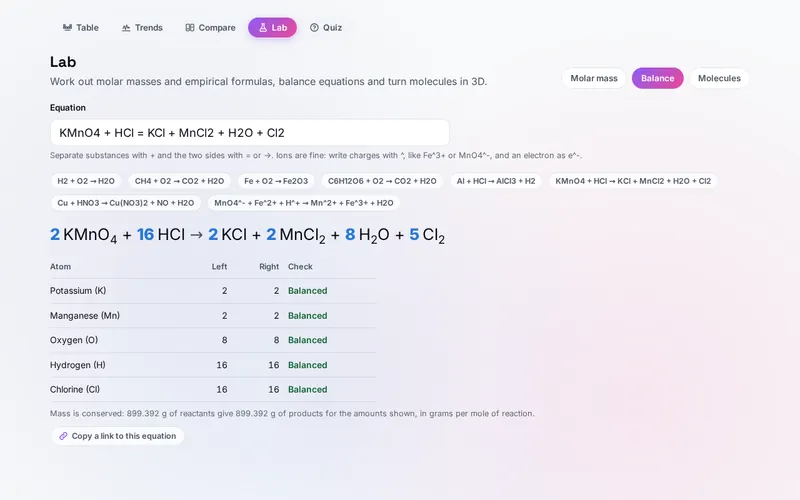
Beside the table sit the calculations students and teachers need most: molar mass of any formula, an empirical formula from an analysis, a balancer for chemical equations with ions, and molecules to turn in 3D. A quiz tests positions, names, symbols and families, or all 118 names from memory.
Every value names its source, from IUPAC's atomic weights commission to the CRC Handbook and NIST, and values that have never been measured are shown as unknown. It all runs in your browser.
Key Features
States at Any Temperature
From absolute zero to the surface of the Sun, each square fills for a solid, half for a liquid and empties for a gas.
The History Replayed
Watch the elements appear from antiquity to 2010, with the moments that shaped the table.
Colour by a Property
Atomic weight, electronegativity, ionisation energy, radius, density, melting point, abundance and more.
Trends and Comparisons
Chart a property across the table, plot two against each other, or put four elements side by side.
Molar Mass
Formulas with brackets and hydrates, the share of each element, and grams, moles and particles.
Empirical Formulas
From the mass percentages of an analysis to the empirical and molecular formula.
Equation Balancer
Molecules and ions with exact whole numbers, and a table that checks every atom and the charge.
Molecules and a Quiz
23 molecules and crystals in 3D with their shapes, and quizzes from ten questions to all 118 names.
How to Use
- Find an element - Search by name, symbol, number or family, or choose a square to open its facts, electrons, story and uses.
- Heat the table - Drag the temperature slider or pick a preset such as liquid nitrogen or lava to see which elements are solid, liquid or gas.
- Rewind history - Move the Known by slider or press Replay history to see the elements appear year by year.
- Look for patterns - Colour the table by a property, chart it on the Trends tab, or compare up to four elements.
- Work it out - In the Lab, type a formula for its molar mass, percentages for an empirical formula, or an equation to balance.
- Test yourself - Play a ten-question round or try to name all 118 elements against the clock.
How the Tool Works It Out
- States - An element is solid below its melting point, liquid up to its boiling point and a gas above it, at normal atmospheric pressure. Helium never freezes at that pressure, carbon and arsenic turn straight from solid to gas, and where a melting or boiling point has never been measured the state is shown as unknown.
- Molar mass - The formula is read symbol by symbol (symbols are case-sensitive), brackets multiply what is inside them and a dot adds water of crystallisation. Each element's count is multiplied by its standard atomic weight and added up; for radioactive elements the mass number of the longest-lived isotope is used, and the result says so.
- Empirical formulas - Each percentage is divided by the element's atomic weight to give moles in 100 g; dividing by the smallest gives a ratio, which is multiplied by the smallest whole number (up to 12) that makes every part close to a whole number. With a molar mass, the molecular formula is the nearest whole multiple.
- Balancing - The equation becomes a table of atom counts (and charges) for each substance, solved with exact fractions for the smallest positive whole numbers. If an element appears on one side only, no positive solution exists, or there is more than one independent solution, the tool says so instead of guessing.
- Checked before publishing - We compared the tool with references made separately: 738,787 cases in 13 groups: every element's atomic weight against CIAAW 2024 and its list of the radioactive elements, melting and boiling points, densities, electronegativity, electron affinity, ionisation energy, radii and crust abundance against the CRC Handbook, NIST and the published radius tables, discovery years against PubChem and Wikidata, the state of every element at every whole kelvin from 0 to 6000, temperatures written in three units, molar masses and Hill formulas of 13,567 formulas (including ones that must be refused) against a separate parser, 1,375 equations against exact linear algebra (936 balanced, the rest correctly refused), 3,020 empirical formulas, saved settings made to break the tool, shared links, search answers and the 3D models. The original version used older atomic weights for argon and zirconium and values from mixed sources, wrote 0 degrees Celsius as minus 0, accepted counts of zero (showing NaN% for H0), accepted an element listed twice in the empirical formula, stopped on a link with a stray % sign and used saved settings without checking them; that is fixed.
Where the Values Come From
Standard atomic weights are those of IUPAC's Commission on Isotopic Abundances and Atomic Weights (CIAAW), Standard Atomic Weights 2024, in the five-figure form CIAAW publishes for everyday use. Radioactive elements have no standard atomic weight; for them the table shows, in square brackets, the mass number of the most stable isotope from CIAAW's list, which rests on the NUBASE2020 evaluation of nuclear data.
Melting and boiling points, densities, Pauling electronegativity, electron affinity and abundance in the Earth's crust come from the CRC Handbook of Chemistry and Physics, through the open mendeleev data set, which records the source of each property. First ionisation energies come from the NIST Atomic Spectra Database, covalent radii from Cordero and others (2008) and atomic radii from Rahm, Hoffmann and Ashcroft (2016 and 2017). Gas densities are those of an ideal gas at 25 °C and normal pressure. Estimates, calculated values for elements that have never been measured in bulk, and predictions are left out, except the predicted electron configurations of the heaviest elements, which are marked.
Discovery years are the year an element was first recognised or isolated, which books do not always agree on. The table follows PubChem's periodic table or Wikidata wherever either agrees, the Nobel Prize citation for fluorine (isolated by Henri Moissan in 1886) and the IUPAC and IUPAP working group's verdicts for elements 102, 105 and 107. This is the site's only periodic table; the ConvertAll conversion calculator turns temperatures and other units into each other.
Frequently Asked Questions
The questions people ask most are answered on the tool page, just below the tool. The full list of 30 questions, from the sources of the values to the temperature slider, the Lab and the quiz, is on the Periodic Table FAQ page, and every part of the tool is explained step by step in the help guide.
Privacy & Security
This tool has no upload step, no account and no server-side storage. The formulas and equations you type are worked out in your browser, and only your settings and best quiz scores are kept, in this browser on this device, once you change one.
The tool asks no outside service for anything; the Read on Wikipedia link in an element's window opens Wikipedia only when you choose it. Like every page on ZeroDataUpload, the tool page shows ads through Google AdSense and counts visits with Google Analytics; the Privacy Policy explains both.
Ready to explore the elements? It's free, private, and runs entirely in your browser.
Open the Periodic Table →Related

Last Updated: November 3, 2026